
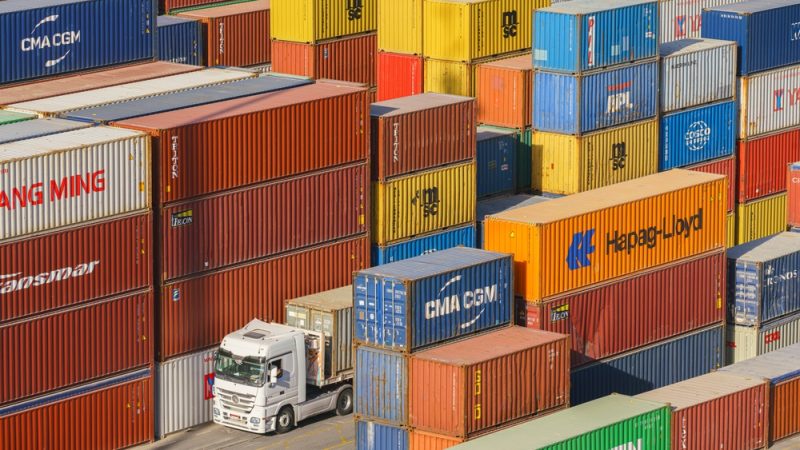
A few weeks ago, container transshipment in the port of Rotterdam was severely affected by a strike by lashing crew members. The strike lasted almost five days and disrupted port and hinterland logistics. With their strike, the lashing crew members put themselves on the map as an indispensable link in port logistics: they were featured in the eight o’clock news almost every day.
Lashing crews are needed to secure containers. They use rods, clamps, tensioners, twist locks, and stackers, among other things. The latter two components are pins, which are needed to secure the containers to the ship and to each other. The rods ensure that the stacks of containers do not fall over and prevent containers from falling off the ship—think of the MSC Zoe, which lost many containers north of the Dutch Wadden Islands a few years ago. In other words: essential work. Securing containers is physically demanding work, which is therefore well paid. A sjorder can earn twice the modal income and, following the recently concluded agreement, significantly more.
There is a lot of talk about robotized terminals, but this overlooks the work of lashers and other service providers such as rowers and pilots. People are still indispensable in container transshipment and can bring ports to a standstill with their actions. For example, Belgian pilots have been protesting since October 5 for better pension conditions and seem set to continue their protest with work-to-rule actions. From October 15 to 24, they were even on full strike for nine days. The obstruction of access to Belgian seaports for seagoing vessels in order to obtain better pension conditions does not seem to be over yet.
We see the lashing of containers as a systemic disadvantage inherent to the container. Although the container may have been proclaimed by one of us as the best invention of the past hundred years, it is not perfect, and the work of the lashing crew is an expression of that. The major economic damage caused by the strike of lashers in the container chain encourages greater attention to be paid to what innovative applications could mean. Innovations that could replace the hassle of stackers and rods. The lashers themselves also consider their work problematic. “Our backs. Your profits” was written on banners during the strike. In 1989, the then-existing Dutch shipping company Nedlloyd designed “open” (hatchless) container ships that made sjorders redundant. Containers “slid” down via a high steel structure that fitted the containers perfectly and did not require the use of stackers or other tools. This increased both efficiency and safety. However, this open technology did not catch on. In the literature—for example, in Jeroen de Haas’s overview “Gard Guide on Freight Containers”—a lack of flexibility for container sizes other than FEUs is mentioned, as well as related risks that these open ships proved unable to withstand.
But there are more disadvantages associated with containers than lashing, which show that this innovation is by no means perfect, such as the transport of empty containers around the world. More than 66 percent of all containers return empty from Europe to Asia. According to analyst Dynamar, Europe imported 18 million containers from Asia last year, but exported only 6 million. That means 12 million containers returned empty. Twelve million times 2 or 2.5 tons of steel (depending on the size of the container) filled with air to Asia. A lot of useless emissions.
A third disadvantage is the instability of the container system. If one ship is stuck in the Suez Canal (the Ever Given), if the Houthis take action, or if the Panama Canal runs dry, ships will sail around South Africa or South America. This throws the entire global system off balance, resulting in major delays and congestion at terminals and in the hinterland. The system is simply too vulnerable: there are plenty of potential bottlenecks. And people exploit that.
Another disadvantage is that there are isolated innovations. In recent decades, container ships have been innovated into giants that can carry more than 24,000 containers—a new world record was recently set with the transport of 22,233 containers on a single ship. But the layout of many container terminals is still geared towards ships carrying 4,000 containers, and the productivity of most cranes is practically the same as it was thirty years ago and has not been subject to further innovation. Larger ships are handled by simply deploying more cranes. This means that certain parts of the container system are innovating much faster than others. This could potentially lead to new vulnerabilities in the future.
There are other disadvantages, such as the fact that more and more containers are being transported to their destination by road rather than by inland waterway or rail. But there are also major innovations in the container system: containers are getting smarter, new terminal designs are available, and we are seeing more and more automated terminals with up to 100% electrification. Container shipping companies are taking over air freight of fruit, using shore power, and more and more ships can in principle run on bioethanol. But we are calling for a fundamental overhaul of the container system aimed at solving the above-mentioned structural disadvantages. This may mean that the container will remain the best invention for another hundred years, but it will be different—and perhaps very different. That is where the challenge lies.
In our country, the know-how is available at universities, specialized organizations, and research institutes. Without structural innovation, the container will remain a familiar sight on our roads—yes, increasingly transported by electric trucks. But it will remain that wonderfully imperfect container whose further development has stalled.
Bart Kuipers and Patrick van de Ven
Bart Kuipers works as a port economist at the Erasmus Centre for Urban, Port and Transport Economics. Patrick van de Ven is a founding partner of Venturn, which has been the leading agency for leadership in the Maritime Supply Chain for 25 years.
This article was originally published in Nieuwsblad Transport on November 7, 2025.