Publicatiedatum: 03-10-2025
Auteur: Daan Berk
The International Maritime Organization (IMO) has announced new regulations aimed at helping the maritime sector achieve net-zero greenhouse gas emissions by 2050. Known as the IMO Net-Zero Framework (IMONZF), this legislation represents a key part of global efforts to curb air pollution from shipping. In October 2025, IMO Member States will vote on the framework’s final adoption. If adopted, the IMONZF will play a crucial role in greening the industry and is likely to have major impacts on shipowners, shipping companies, and other maritime businesses worldwide. This article will explore the framework in detail and outline its anticipated effects. In addition, this article will compare the IMONZF with FuelEU Maritime, building upon previous Venturn articles.
What is the IMO Net-Zero Framework?
The legislation is designed to measure and reduce ships’ greenhouse gas emissions on a Well-to-Wake basis (from source to use). It sets and limits the greenhouse gas intensity of the fuels maritime companies consume. Over time, the framework will impose caps on the maximum allowable fuel-related greenhouse gas intensity.
Compliance is tiered. Companies that fail to meet the least stringent standard, called the “basic tier,” must pay a tax of $380 per tonne of CO₂-equivalent emissions. This calculation covers not only CO₂ but also other harmful gases such as methane (CH₄) and nitrous oxide (N₂O).
Companies that meet the basic tier but miss the strictest standard (direct compliance) face a tax of $100 per tonne of CO₂-equivalent. Firms achieving direct compliance earn emission credits for avoided emissions. They can hold these credits for future use or transfer them to ships within a predefined group that fall short of direct compliance.
Which entities does the IMO Net-Zero Framework apply to?
The framework covers internationally operating ships of 5,000 gross tonnage (GT) or more. These vessels must comply with the specified emission standards. Exemptions include military and non-commercial ships, non-self-propelled vessels, non-mechanically propelled craft, and semi-submersible ships.
Revenue from Taxes
Revenues from IMONZF taxes will fund the IMO Net-Zero Fund. This fund serves multiple purposes and is central to driving sectorwide decarbonization. First, it will subsidize the emission credits of the most climate-friendly ships.
Second, it will support innovation, research, infrastructure development, and other energy-transition initiatives in developing countries. A portion of the fund will incentivize the use of ZNZs (Zero and Near-Zero fuels, technologies, and energy sources). It will also advance the broader IMO GHG strategy through training, technology transfer, and capacity building. Finally, fund revenues will help mitigate any adverse impacts on vulnerable nations. Specific details of the IMO Net-Zero Fund’s operations have yet to be finalized.
Interaction with Other Legislation
Alongside the IMO Net-Zero Framework, the maritime sector is subject to several existing environmental regulations, such as FuelEU Maritime, the Carbon Intensity Indicator (CII), the EU Emissions Trading System (EU ETS), and design-and-efficiency standards like EEDI and EEXI. Shipowners and maritime companies face additional costs from taxes, administrative requirements, and investments in more sustainable vessels.
The fuel intensity targets of the IMO Net-Zero Framework differ from those under FuelEU Maritime. The chart below illustrates the intended maximum greenhouse gas intensity of fuels over time for FuelEU Maritime, the IMONZF basic tier, and IMONZF direct compliance. While IMONZF targets are officially set only through 2030, the lines have been extended here to the net-zero goal in 2050.
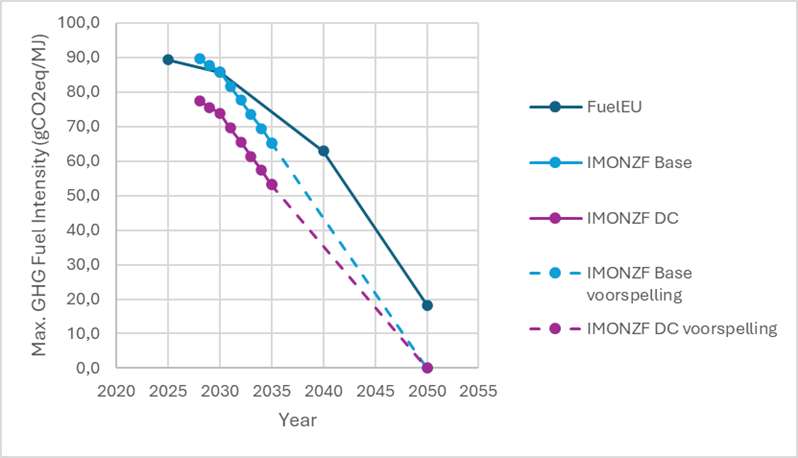
Until 2023, the IMO Net-Zero Framework allows higher fuel intensity than FuelEU Maritime; thereafter, its targets become more stringent than those of FuelEU Maritime.
It remains unclear whether adopting the IMO Net-Zero Framework will prompt adjustments to existing laws or how administrative processes might be streamlined across different regulations.
What options are there for decarbonization?
Shipping has multiple pathways to reduce emissions. Under the IMO Net-Zero Framework, which focuses on fuel greenhouse gas intensity, measures that lower fuel intensity are especially effective. Examples include switching to alternative low carbon-intensity fuels.
Beyond fuel choice, technological innovations such as wind propulsion, solar power, and carbon capture and storage systems can also cut emissions. The IMO has stated that all technologies, fuels, and energy sources will be assessed on a Well-to-Wake basis for their suitability under the IMONZF.
Timeline
The draft regulations were approved by IMO Member States in April 2025. In October 2025, the Member States will vote on final adoption. If approved, the framework will formally enter into force on March 1, 2027, and its requirements will apply to shipping from January 1, 2028.
Controversy in regulation adoption
The framework has faced several objections. For example, U.S. President Donald Trump has spoken out against the framework. The U.S. government has also announced that it will impose sanctions on states that vote in favor of the IMONZF. In addition to the U.S. government’s statement, various shipping companies and other organizations have expressed their opposition to the framework in a joint declaration. At the same time, other organizations and governments have voiced support for the framework and its potential impact on promoting sustainability in the maritime sector. It is currently unclear how IMO member states will vote on the framework.
What is Venturn’s role?
Venturn is closely monitoring developments around the IMO Net-Zero Framework and other relevant emission regulations. The new rules create both opportunities and risks for maritime companies. Venturn helps clients identify and strategically leverage these factors. By sharing expertise and offering insight into compliance and decarbonization options, Venturn supports companies in making informed decisions in a rapidly evolving environment.