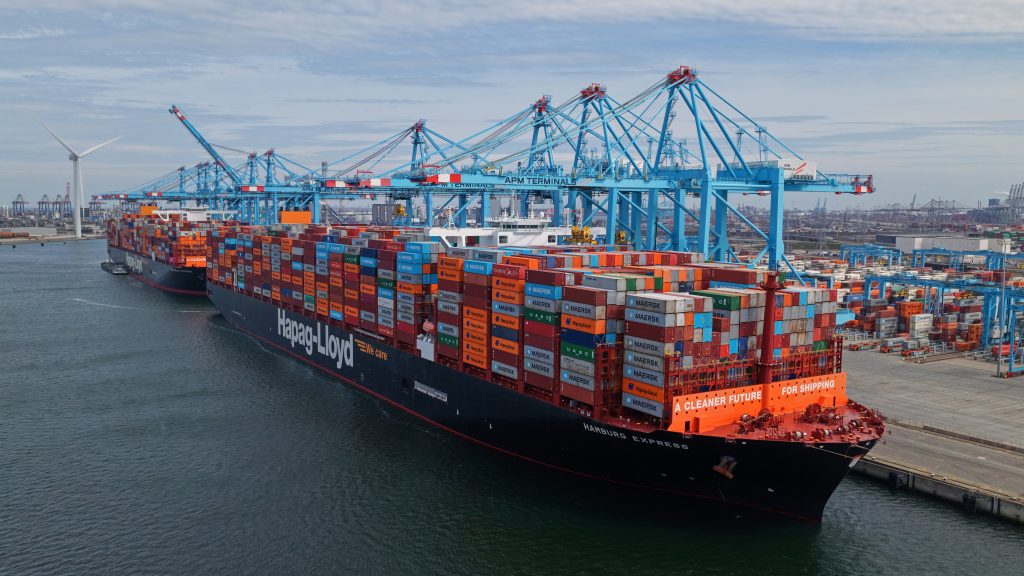
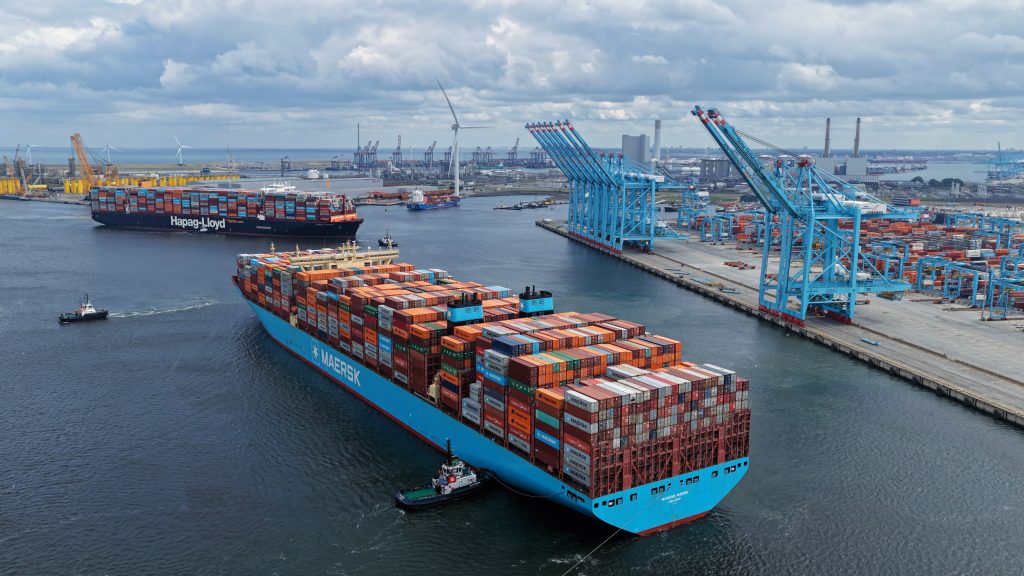
The distinctive blue cranes of APM Terminals Maasvlakte II tower like landmarks above the hundreds of colourful containers on the quay and the container ships. Hub Transformation Leader Wouter Boogaart only has to look out of his window to see the impact of his work. Wouter (36) first came into contact with Venturn as a recently graduated professional. Today, he now works together with Venturn in the fields of Leadership Development and Advisory, and there is always a Venturn Young Professional on site. This is his story about the interaction and collaboration with Venturn.
APM Terminals Maasvlakte II is, as Wouter aptly puts it, an essential link in global trade. Thousands of containers pass through Rotterdam every day, on their way in or out of Europe. The terminal is highly automated and sustainable. “Everything that moves is powered by electricity, and all the electricity comes from green energy,” explains the Hub Transformation Leader. Crane operators no longer sit up in the crane but control the systems remotely from their office. Automated Guided Vehicles operate in a secure area and change their batteries autonomously. And importantly: people and machines are strictly separated. This contributes to an efficient and safe working environment.
“Safety is the most important thing. Everything we do is aimed at ensuring that people can do their jobs safely.”
Focus and rhythm
His role as Hub Transformation Leader consists of three interconnected areas. He translates the local strategy into concrete, achievable goals across all levels of the organisation. He helps the organisation to work according to the Lean way of working. And he maintains an overview of all ongoing initiatives: where are the priorities, where should the focus lie, and how does the organisation stay on track? This is particularly important, given that APM Terminals is set to double its capacity within a considerable timeframe through the expansion of the deep-water quay.
In a world that is so technical and automated, improvement for him starts with people. “What I like about lean is that it really focuses on the role of the person in the terminal’s process. You have people, process and technology. Lean really starts with the people.”
According to him, knowledge is not found in a meeting room, but on the shop floor, amongst the people who deal with processes, machines and customers on a daily basis. “Go to the shopfloor. Listen to them. And give the people who actually know the job the responsibility, the trust and the space to improve their work.”
That’s also where the leadership issue comes in, an area in which he has been working with Venturn for some time as part of their Leadership Development programme. Because providing direction is essential. An organisation needs a clear ambition. “You want to set that out from the top down. This is our strategy. This is where we want to grow. This is what’s needed to get there.” But you don’t want to map out the path to that goal in stone. “Instead, you want to draw on the strength, knowledge and experience that exist within the company to shape how this is achieved.”
Area of tension
For Wouter, leadership comes together in this area of tension. On the one hand, an organisation needs to know where it is heading. On the other hand, people need the freedom to contribute in their own way. This is particularly true in an operation where safety, innovation and continuity matter every single day. “Fostering a drive to improve things from the bottom up only works if it is encouraged by the leaders within that company,” says Wouter. This is where his work ties in directly with the collaboration with Venturn.
For the past two years, Dirk Paans from Venturn has been supporting Wouter and his colleagues. “On the one hand, it’s about looking ahead, setting a direction – where do we want to go? At the same time, Venturn helps us with leadership development. How can you, as a leader, get the most out of yourself and the most out of your team?”
He makes it clear that this involves creating high-performing teams. “And high-performing teams exist vertically within your organisation, but also horizontally and cross-functionally.”
Therefore, leadership is not just about communicating strategy for Wouter. It’s also about knowing yourself. About your strengths and pitfalls. About your communication style. About how you develop team members, about how you keep people engaged and about how leaders work together. Venturn supports Wouter and his colleagues in that process.
That requires openness. And openness requires mutual trust. That is precisely where Wouter sees the value of Venturn. “If that trust isn’t there, it remains a one-way communication. Then, as an external party, you just keep explaining things. If it doesn’t become a dialogue, you’ll never really get to the heart of the matter.”
Long-standing partner
The relationship between the 36-year-old manager and Venturn did not begin with the leadership programme at APM Terminals. It started much earlier. Eight years ago, he participated in a data science training at Venturn, because during his first job at Anthony Veder he had noticed how many decisions were made based on experience and gut feeling. “You’d hear things like: that won’t work, because we tried it ten years ago and it didn’t work out then.” The training helped him to offer well substantiated alternatives. “I thought: this is going to help me develop a combination of skills and competencies that will take my career further and make me a valuable asset to the maritime industry.”
He stayed in touch with Venturn. Even when Wouter wanted to return to the maritime sector after a few years at McKinsey&Company. “Patrick van de Ven said: ‘I think this suits you, and vice versa. In terms of personality, knowledge and skills.’” According to Wouter, this is a great example of Venturn’s personal approach and its knowledge of the sector.
Building trust
When Wouter joined APM Terminals, Venturn already worked on the terminal. Dirk Paans was working with the organisation on leadership and team development as part of Venturn’s Leadership Development programme. “We combined these elements, structured them more strategically and rolled them out as a programme, which we have now been running for two years.”
In practice, this means working closely together. In his role as Hub Transformation Leader, Wouter is responsible for the management offsites, bringing together between eleven and forty members of the executive board and management, depending on the group’s composition. In the run-up to management offsites, Wouter and Dirk discuss the format, structure and content. Where does the organisation stand? What is the next step? What needs to be discussed? Where are the tensions? Where should the team try something new?
For Wouter, this is also where the added value of an external guide like Venturn lies. “Venturn brings additional expertise and experience to the table, which helps us to further professionalise our leadership development. We are a container terminal, specialising in the loading and unloading of ships. Venturn specialises in leadership development. They have far more knowledge, skill and expertise in this area than we do.”
But expertise alone is not enough. “Venturn is sufficiently removed from our day-to-day operations to be able to take a clear-eyed view and hold up a mirror to us from time to time. That means Venturn provides independent advice, unhindered by potential internal relationships and sensitivities.”
Wouter particularly appreciates that Venturn does not simply confirm what the organisation already thinks. “Some consultants will try to tell a client exactly what they want to hear. Venturn doesn’t do that. They’re not afraid to be critical, to ask tough questions and to push you every now and then to do something uncomfortable.”
That dynamic only works if the foundation is right. “There’s a layer of trust underneath,” says Wouter. This has been built through successes, shared ambition, reliability and quality. “When we commit to something, it happens. There’s consistency. There’s knowledge and expertise. What we see is that it works.”
Venturn’s understanding of the maritime sector helps with that. According to Wouter, they understand how the sector works, with all its sensitivities, peculiarities, complexities and risks. “As a result, the advice they give is tailored to that. They don’t come up with ideas that might be normal in aviation or healthcare, but which won’t work here. You don’t even need to discuss that. We both know how it works.”
Sheep herding as a mirror
The best example of that deepening trust emerged during the preparations for a management off-site, the sort they’d already done seven or eight times. “We always brainstorm to shape a programme like that. To make it engaging, interesting and challenging.”
Right from one of the very first times, Dirk came up with an idea. Shouldn’t they go sheep herding with the management team? Wouter can still picture himself reacting. “Just imagine: a group of Rotterdam Port Managers herding sheep, of course we’re not going to do that. It’s already quite something that we sit down together in a hotel and have a beer.”
That was two years ago. At the most recent off-site, the idea came up again. This time it felt different. “This time we really felt: We’re ready for this now.”
That says a lot about what has been built up in the meantime. Wouter had enough confidence in Dirk to take the suggestion seriously. Dirk had built up enough trust with the senior management team to be allowed to lead such an intervention. And the team trusted each other enough to embrace the experience.
Sheep herding turned out not to be a light-hearted outing, but a direct reflection of leadership, Wouter makes clear. “A sheep doesn’t understand you. It hears you, but it doesn’t get you. And yet you still try to lead a group of sheep like that and get them to follow a certain route. That reveals a lot about your leadership style. A flock of sheep will react to you in the same way.”
The metaphor is crystal clear. “If you stand very close to them, because that gives you a sense of control, the group will run away. That’s the same in real life. If you stand very close to people in a team and start micromanaging, because that gives you a sense of control, it often backfires.”
Two years earlier, this wouldn’t have worked. Now it has. “We definitely wouldn’t have done this with that group two years ago. We’ve accepted Dirk as our coach.”
Personal leadership style
For Wouter, the collaboration with Venturn is also a personal one. He describes himself as a novice leader. “I’m still developing my leadership style every day. Venturn helps me with that.”
It starts with self-awareness. Awareness of his personality, character, strengths and areas for improvement. Awareness of his natural leadership style. This is then put into practice. “Dirk coaches and guides me through that.” The conversations cover situations that Wouter brings up from his own day-to-day. What challenges does he face? Which leadership style suits which situation? Which responsibilities do you assign to whom? How do you develop a team? How do you build a high-performing team?
Wouter compares it to baking a cake. “I’ve got all the ingredients here. But how do we turn them into a cake? That’s where Venturn helps me.” This helps him to build a high-performing team and gain confidence in his leadership style. “That I’m given the confidence to make difficult decisions from time to time. That it’s okay if not everyone is always happy with the decision you make. That you can say: I stand by this; this is how we’re going to do it.”
The impact of Venturn
The impact of Venturn does not lie in a single intervention or one training day. It lies in a movement. Wouter is becoming more effective and efficient. His team is becoming better positioned. And that has a knock-on effect throughout the organisation. “With Venturn, we focus a great deal on giving my team space and responsibility, and on not getting too involved or micromanaging. We see that scope for decision-making and autonomy – and consequently the effectiveness and speed of our operations – reflected in issues discussed at various levels.”
And, reflecting on himself: “The better I am in sync with my team, the more we can achieve together within the company. I think we’re currently in a positive, upward spiral.”
This approach is in line with his role as Hub Transformation Leader. Ultimately, the work should not be carried out by a separate improvement team, but by the organisation itself. “There’s no point in building a huge continuous improvement team alongside the existing organisation. It’s the existing organisation that needs to take it on. It’s better to have a small centre of excellence and use that to help lift the organisation.”
VYP trainees as a source of fresh energy
The partnership between APM Terminals Maasvlakte II and Venturn goes beyond leadership development alone. APM Terminals also works with VYP trainees: young professionals who are gaining experience in the sector through Venturn.
They bring something that every organisation needs, believes Wouter. “New energy, a fresh perspective. Young men and women with a real drive to get things done. They ask interesting, critical questions, come up with unexpected ideas and are keen to get stuck in.”
They bring new skills and a fresh perspective. “There are lots of things they can do that we cannot. At the same time, they know very little when they first arrive here. They have often just left university. You really see them grow from students into professionals.”
Part of that development takes place within APM Terminals, partly through the community and support of Venturn. And partly because they’re quickly given a place within the organisation. “They bring that outsider’s perspective. Why cannot this be done? Because you tried it ten years ago? Well, we’re going to give it another go. That gives me energy.”
Four things that are typical of Venturn
Ask Wouter what is typical of Venturn, and he comes up with four points. “For me, it comes down to a few things. Firstly: they know the sector, the industry and the culture. That’s a prerequisite for being successful within this sort of company.”
Besides that, they’re very adept at navigating the full spectrum from strategy to execution. They can contribute ideas on long-term planning and vision, but they’re also very hands-on when it comes to implementation: developing people and leaders.”
And importantly: “They’re in it for the long run. They build a foundation of trust. And that’s not something that just happens automatically if you spend enough time together. They work hard on it. They do the right things and actively build that trust.
“And something else I’ve really noticed: they have an eye for the individual. I first came across them as a young, recently graduated professional looking to undertake a data science training course and eventually ended up at APM Terminals Maasvlakte II via Executive Search. They work on building relationships. Not just with CEOs, but also with young people at the start of their careers. They keep an eye on them too. This really creates a community around Venturn: a mix of young, old, experienced and inexperienced people. That’s typical of Venturn.”
Wouter Boogaart – Hub Transformation Leader
Wouter Boogaart has been Hub Transformation Leader at APM Terminals Maasvlakte II since 2024. In this role, he is at the foundation of one of the most impactful phases in the terminal’s development: a large-scale transformation in which capacity, complexity and ambition are all increasing simultaneously. His mission is clear: to connect, structure and accelerate all the changes needed to make APM Terminals Maasvlakte II future-proof.
His ambition is to build an organisation within APM Terminals Maasvlakte II in which continuous improvement is a structural part of day-to-day work: data-driven, structured and supported by the entire organisation. An environment in which people help, trust and challenge one another, and in which transformation is not a temporary phenomenon, but a permanent way of working.